SIBU: Sarawak continues to move forward in its efforts to become a regional green energy hub by 2035, in line with the country's aspiration to emerge as the 'Battery of ASEAN'.
Minister for Utility and Telecommunication, Dato Sri Julaihi Narawi said the state currently has an electricity generation capacity of 5.8 gigawatts (GW), compared to the current demand of around 4.897 GW, thus providing a significant energy surplus to expand industrial development.
According to him, the power generation capacity is expected to increase to 10 GW by 2030, and to 15 GW by 2035, with 60 per cent of it contributed by renewable energy sources.
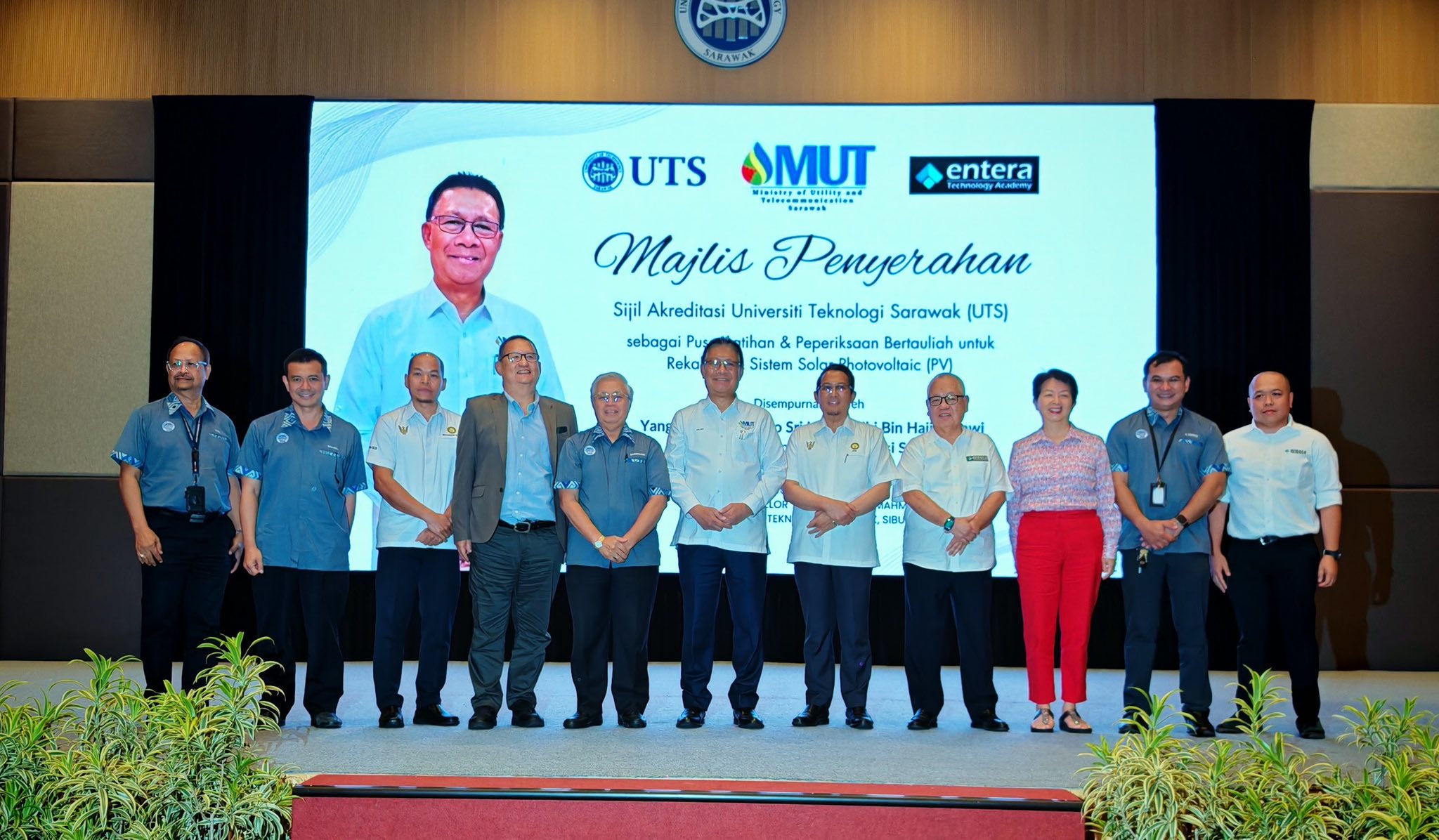
"This means that the majority of Sarawak's electricity is generated from clean and environmentally friendly sources," he explained when speaking at the Certificate Presentation Ceremony for the Accredited Training and Examination for Solar PV System Design at the Universiti Teknologi Sarawak (UTS) here on Monday.
The ceremony was a collaboration between UTS and Entera Technology Academy Sdn Bhd, also attended by Entera Managing Director, Ir. Dr. Abang Hatta Abang Taha and UTS Vice-Chancellor, Professor Datuk Dr. Khairuddin Ab. Hamid with the presence of about 100 participants.
Meanwhile, Dato Sri Julaihi added that Sarawak is currently actively implementing floating solar plant projects in several major dams in the state such as Batang Ai, Murum and Bakun.
According to him, in the Batang Ai dam alone, solar energy with a capacity of 50 megawatts (MW) has been generated since last December while using only three per cent of the dam's surface.
“This proves the great potential of floating solar energy which could be more widely utilised. We aim to generate up to 1,500 MW of solar energy in the future," he said.
Commenting on the need for human resources, Dato Sri Julaihi stressed that the development of the green energy industry must be supported by a skilled and certified workforce.
In this regard, UTS and Entera have been granted accreditation to train professionals in the field of design and installation of solar PV systems.
"We are building a workforce ecosystem throughout Sarawak in collaboration with 32 training centres, including to train chargemen, installation electricians, wiremen and so on," he said.
He also linked workforce development to the Post-COVID-19 Development Strategy (PCDS) 2030, which targets high-income economic growth through six priority sectors, including renewable energy.
"Electricity is a key driver of economic development.
"Sarawak has great potential in green energy and we are ready to play an important role as the 'Battery of ASEAN'," he stressed. -UKASnews