SIBU: All the four venues in Sibu are ready to host the sports contingents participating in the three sporting events for SUKMA 2024, namely volleyball which will be held at the Sibu Rejang Park Indoor Stadium, badminton at the Sibu Indoor Stadium, and football at the Tun Ahmad Zaidi Stadium and the Azman Hashim Community Sports Centre at Sibu Jaya.
Brief history of Sibu
Sibu town or Swan City has a population of about 250,000 and lies at a strategic location at the confluence of the Rajang and Igan rivers. Besides being the name of the town itself, Sibu is also the name of the third division of Sarawak which consisted of three districts, namely Sibu, Kanowit and Selangau.
The history of the settlement of the Swan City can be traced back to the first White Rajah of Sarawak, Sir James Brooke when he acquired the territory from the Brunei sultanate in 1841. At that time the earliest settlers in the Sibu region were mostly the Melanaus with smaller groups of Ibans and Malays.
According to historians, the village of ‘Sibau’ appears to have been named after the wild rambutans found in abundance along the river basin.
Sibau is the Iban word for rambutans.
This name apparently was given by the first Sibu Resident on June 1, 1873. Before that, the town was called ‘Maling’, after Tanjung Maling, a fishing and farming village, located at the confluence of Rajang and Igan rivers.
The earliest Chinese arrivals of Foochow origin can be traced to the 1860s with the building of two rows of shophouses around Sibu Fort which was set up to serve as an administrative centre by the Brooke government.
According to the Sarawak Gazette, on 24 January 1871, there were 60 wooden shops in Sibu. And in 1873, the third division of Sarawak was created which included the town of Sibu.
In the late 19th century, a prominent Foochow named Wong Nai Siong, who has migrated from Fuzhou, Fijian Province, China played a crucial role in the overall development of Sibu when he brought his countrymen to settle down in Sibu town.
To honour his contributions to Sibu, the Sarawak government has named a few prominent landmarks including a secondary school, and road and a park named after him.
In the early 60’s to the 90’s Sibu was well known as the timber-hub of Sarawak with the Chinese, Iban, and Malays as the main ethnic groups. However, there are large number of Melanaus residing at Kampung Nangka and Kampung Datu areas.
The swan has been chosen as the official icon of Sibu as the early Chinese settlers reminded them of the Swan River in Fuzhou, China. The swan too symbolises fidelity, commitment, wisdom, grace, inner beauty, ability to see the future, understanding spirituality and the ability to deal with others.
Sibu – a food haven
Sibu is well known for its reasonably delicious but cheap food. For instance, you can have a bowl of
kampua mee which will cost only RM6 compared to RM8 or more in other towns in Sarawak. Besides
kampua, which is Sibu’s unique specialty as it is closely linked to the Foochow community. Of course there are noodles such as
kolo mee,
mee basah (fried noodle soup),
mee suah and
dian mian ngu (rice noodle).
Many famous coffeeshops in Sibu town are within walking distance from the hotels without the need for transportation. This is one unique thing about Sibu, where almost everything you may need, from toiletries to personal items are within walking distance. Furthermore, many of these coffeehouses of
kopitiam also offered halal food too.
On the other hand, if you prefer a higher end food, there are many restaurants that are located within walking distance from major hotels in Sibu town.
Sibu night market
If one is hungry or thirsty soon after dinner, then the Sibu night market is a must visit place where there is a wide array of local dishes including desserts, barbeque meat,
bachang (Chinese ketupat) and there are a wide range of Malay pasties and cakes too such as the
apam balik. To top it off, there are plenty of stalls that offer assortment of fresh fruit juices to quench the thirst.
Besides food and drinks for night snacks, the Sibu night market also offers myriads of items; from toys to torchlights, and stuffs that one might suddenly need, when one may have forgotten to bring along, such as nail clippers, scissors, penknife and even bottle openers.
Sibu wet market – the biggest wet market in Malaysia
The Sibu wet market is known to be the biggest in the whole country. It provides livelihood to all the ethnic groups in Sibu to ply their trade which include jungle produce and home-grown vegetables, fruits and poultry.
One of the main attractions at the Sibu wet market is how they put
ayam tua (old or expired chicken) for sale as they are wrapped up with newspapers and tied with nylon strings. It is a unique way of selling chicken.
Sibu regional express boat wharf
The Sibu regional express boat wharf was built to cater for river transport needs for the whole central region. It used to serve as a hub for river express for major towns such as Belaga, Kapit, Song and Kanowit before major roads leading to these towns were completed just recently.
However today, the wharf is a far cry of what it used to be when hives of activities started as early as 4 a.m., and passengers getting ready to board the express boats to their various destinations. But it is still worth a visit to reminiscence the good old romantic ways of traveling in Sarawak central region.
Sibu Pagoda
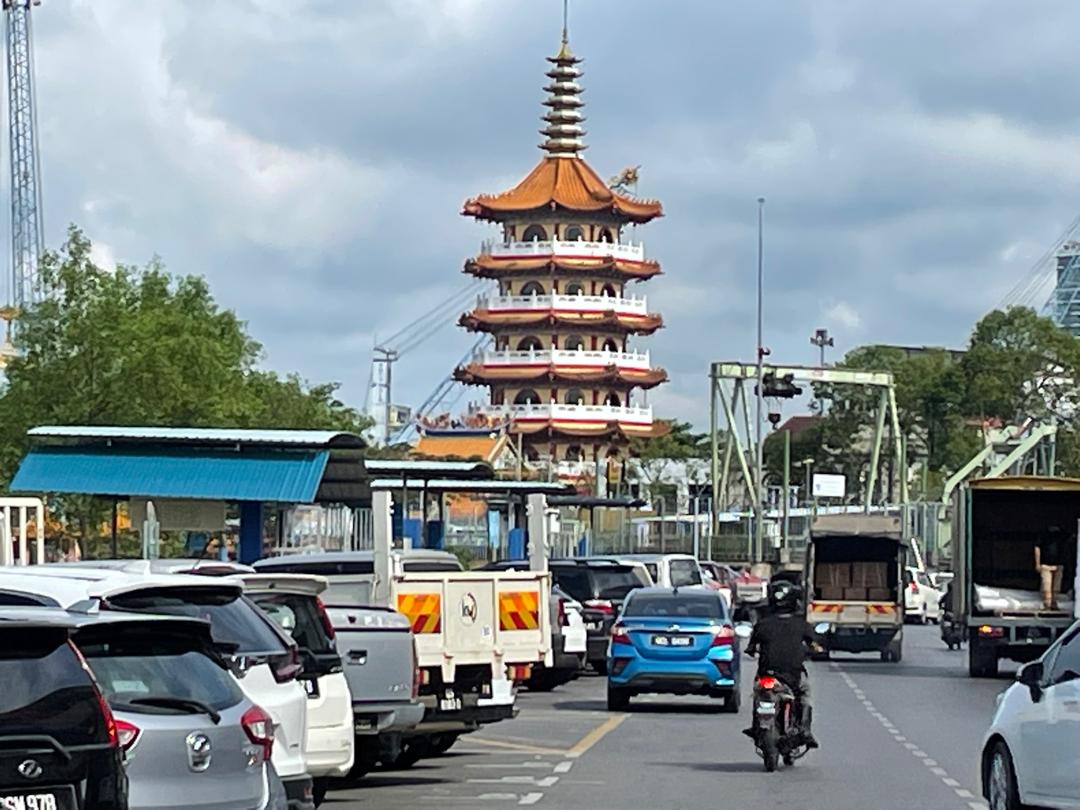
The seven-storey Sibu Pagoda is the only such unique structure found in Sarawak. It is built within the compound of a Chinese temple but access to view the town from the top level of the pagoda is always permissible.
It is also a prominent landmark in Sibu town as is built on the bank of the mighty Rajang River, overlooking almost the whole of Sibu town from the topmost level. With the help of a telescope which the temple management had fixed at the top level, one can have a fantastic view of the whole town.
Wong Nai Siong Garden at Sungai Merah
A garden was built where Wong Nai Siong first landed in Sibu at Sungai Merah. The garden is unique as it portrayed the life and contribution of the late Nai Siong for the overall development of Sibu town. However, one may need a translator to know the details of his life story as it is written in Mandarin.
Sibu Chinese temple – the biggest in Malaysia
The Sibu Chinese temple is located about 30km from Sibu town and built on a large piece of land. At the two large entrances of the temple, one can see dragon sculptures welcoming visitors to the main temple area.
Within the temple, there are many chambers that one can explore. However, similar to the Wong Nai Siong Garden, one may need a translator as the writings in the temple area are in Mandarin.
The Sibu temple has been recognised as the biggest temple in the whole country. -UKASnews