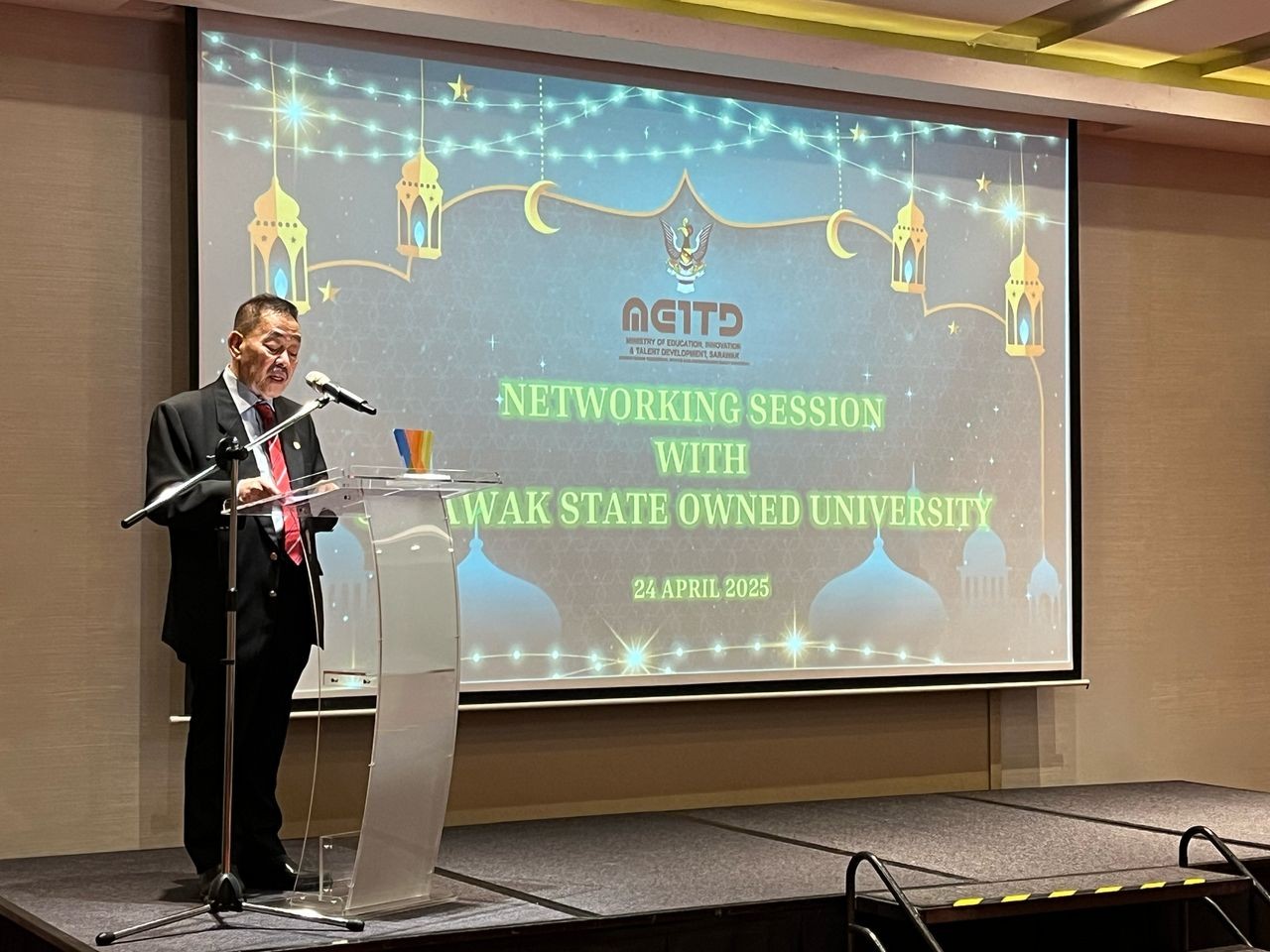
KUCHING: The Sarawak Government reaffirmed its commitment to transforming the state’s education landscape.
As such Minister for Education, Innovation and Talent Development, Dato Sri Roland Sagah Wee Inn, emphasised the importance of fostering meaningful collaboration among educational stakeholders.
He said this in his speech during a networking session with Sarawak State Owned University stakeholders held here on Thursday,
“This session is an opportunity to forge stronger ties, open dialogue, and explore collaborative opportunities that benefit our students, industries, and the state,” he said.
He acknowledged the invaluable roles played by various institutions in nurturing academic excellence, advancing research, and equipping youth with skills for future economic demands.
The event brought together leaders and representatives from higher learning institutions, skills development agencies, and key government bodies.
Highlighting the state's forward-looking education agenda, Dato Sri Roland Sagah reiterated Sarawak’s plans to implement the Free Tertiary Education Scheme (FTES) beginning in 2026.
The scheme will cover tuition fees for Sarawakian students pursuing undergraduate degrees at state-owned institutions such as Swinburne University of Technology Sarawak, Curtin University Malaysia, University Technology Sarawak (UTS), and i-CATS University College.
In a move to further support underprivileged students, the FTES will also include an annual RM15,000 stipend for students from households with a per capita income of RM1,500 or below.
This provision aims to ease the financial burden on families and promote equitable access to higher education. Currently, the scheme covers 64 designated undergraduate programmes that align with Sarawak’s economic development needs.
“The FTES reflects our belief that education is a catalyst for social mobility and economic advancement,” Dato Sri Roland Sagah said. “We are committed to removing barriers so that every Sarawakian, especially those from rural and disadvantaged backgrounds, has the opportunity to succeed.”
He linked this initiative to the broader goals outlined in Sarawak’s Post COVID-19 Development Strategy 2030 (PCDS 2030), which targets high-income, developed state status by the end of the decade.
He also explained the rationale behind the targeted nature of the stipend, stating, “We must embrace equity over equality. While equality treats everyone the same, equity recognises differing needs and starting points. Our policy ensures no one is left behind.”
Beyond FTES, the Minister outlined several ongoing and future initiatives. These include strengthening STEM education through the development of Science Centres, upgrading educational infrastructure, expanding Technical and Vocational Education and Training (TVET), and addressing disparities between urban and rural education standards.
“These efforts aim to produce a competent, science-literate, and industry-ready workforce,” he noted.
International partnerships will also play a vital role in improving the quality of education in Sarawak.
Collaborations with global institutions are expected to provide both expertise and opportunities for knowledge exchange, enhancing academic standards across the board.
Dato Sri Roland Sagah acknowledged the collective effort required to achieve these ambitious goals, urging stakeholders to take full advantage of the networking session to identify areas for synergy and cooperation.
As the session concluded, the Minister reiterated the government’s dedication to inclusive education policies that support all 'Anak Sarawak'.
He called upon participants to continue engaging in constructive dialogue and collaborative efforts that ensure a thriving and equitable future for the next generation. -UKASnews